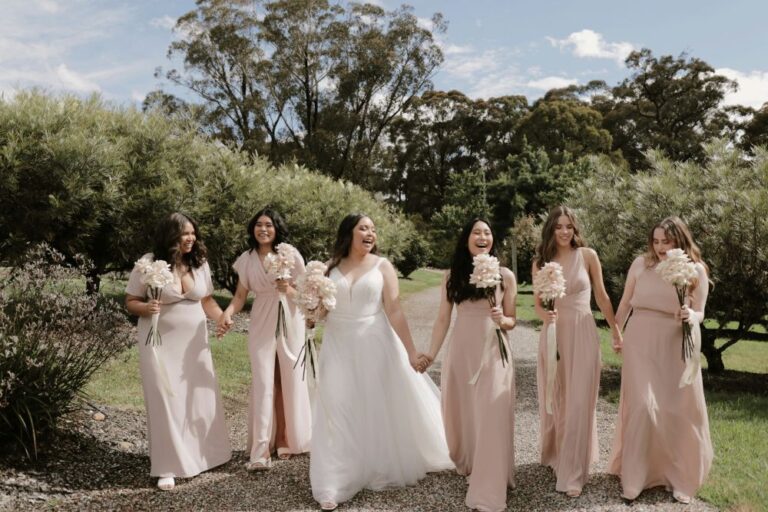
So you’ve planned the wedding. Venue booked (probably somewhere stunning in the Yarra Valley, Mornington Peninsula, or a chic Melbourne city warehouse, let’s be honest). Vendors secured. Pinterest boards completed. Budget spreadsheet mastered. You’re organized, prepared, and ready.
Except nobody has actually told you what it’s like to be a bride on your wedding day in Melbourne.
Not the planning part. The actual being-a-Melbourne-bride part.
Nobody mentions that you’ll need to plan for four seasons in one day and your dress needs to work for all of them. Nobody warns you about the specific challenge of outdoor photos when the weather forecast has changed three times in 24 hours. Nobody explains that your beautiful cathedral-length train will be gorgeous for photos and then spend the rest of the day collecting autumn leaves from the Yarra Valley or wet grass from the Mornington Peninsula.
This is that guide. The one that tells you the things your married friends forgot to mention, your bridal boutique didn’t think to explain, and your coordinator assumes you already know.
This is the ultimate Melbourne bride survival guide for your actual wedding day.
Let’s Talk About Your Dress (The Reality Version)
You bought the dress. You love the dress. You’ve had multiple fittings. You look stunning in the dress.
Now let’s talk about spending 10-12 hours in that dress while navigating a Melbourne wedding, which may involve four different weather conditions.
The Bustling Situation (This Is Not Optional)
Here’s what happens: You have this gorgeous train. It’s romantic and elegant and photographs beautifully against the Yarra Valley mountains or Mornington Peninsula coastline. Then the ceremony ends and suddenly you’re trying to walk through a vineyard with six feet of fabric dragging behind you collecting grass, autumn leaves, and possibly mud (this is Melbourne, after all).
The bustle is essential. And here’s what nobody tells you: you won’t be doing the bustling. Someone else will. And they need to practice.
Two weeks before your wedding, schedule a bustle rehearsal. Not the week of, when everyone’s busy. Two weeks out. Invite whoever will be doing this on the day—usually your maid of honor or mother, sometimes both.
Put on the dress. Have them practice the bustle. Most dresses have either a button bustle (simple) or a French bustle (less simple). Either way, it takes practice. There are loops, buttons, hooks, or ribbons in specific sequences. Some dresses have three or four points that need to be secured in a particular order.
Time how long it takes. The first attempt might take 15 minutes of fumbling. By the third practice run, it should take 2-3 minutes. That’s what you want.
Take photos or video of the bustle. Show them which loops connect to which buttons. Your bustle-er will be nervous on the day. Having a reference photo on their phone helps.
Pro Melbourne tip: If you’re having photos at the Yarra Valley or Mornington Peninsula, many photographers do some shots with the train down (gorgeous), then bustle it for moving around. Plan for a 5-minute bustle break in your photo timeline. If the weather turns, you might bustle earlier than planned to keep your dress clean and dry.
The Bathroom Reality
Let’s just address this directly: using the bathroom in a wedding dress is an operation.
Most Melbourne brides will tell you they either severely limited fluids (bad idea, you need energy for a long day) or they developed a sophisticated bathroom strategy (much better idea).
The bathroom buddy system: Designate someone as your bathroom assistant. Usually your maid of honor. They need to know they have this job. They need to be prepared.
Practice at your final fitting. Seriously. Ask your bridal consultant to talk you through it. Different dress styles require different strategies:
- Ball gowns: Everything gets gathered up and held
- Fitted dresses: The slight shimmy-and-lift technique
- Dresses with buttons down the back: Someone’s coming in with you, accept this now
Melbourne venue bathroom intel:
- Yarra Valley estates: Range from spacious modern to cozy historic. Most are beautiful but variable in size.
- Mornington Peninsula wineries: Generally good facilities, modern venues have better bathrooms.
- Melbourne city venues: Usually spacious modern facilities.
- Dandenong Ranges venues: Historic buildings often have smaller period bathrooms, plan accordingly.
The kit: Have someone keep a small bag with: baby wipes, stain remover pen, double-sided tape, safety pins. You’ll be grateful.
Walking, Standing, and Generally Moving in Your Dress
You’ve practiced walking down the aisle. Great. But you’ll also be:
- Walking through grass (Yarra Valley estates, Mornington Peninsula properties, any regional venue)
- Walking on gravel (every vineyard driveway in Victoria)
- Potentially walking in drizzle (this is Melbourne)
- Standing for 20+ minutes during your ceremony
- Sitting down for dinner (the dress goes where?)
- Dancing (this is… a whole thing)
Practice walking on different surfaces. Put your dress on at home and walk around your garden. Walk on carpet, tiles, grass. You need to know how the dress moves, where you step, how to manage the train.
The ceremony standing situation: You’ll stand at the front for 20+ minutes. In heels. Don’t lock your knees (you’ll faint, this happens regularly). Slightly bend your knees, shift weight foot to foot subtly. Nobody will notice, and you won’t pass out.
Melbourne weather consideration: You might start your ceremony in sunshine and finish it with clouds rolling in. You might have planned an outdoor ceremony and pivot to indoors. Your dress needs to work for both scenarios. If there’s any chance of weather changes (there always is in Melbourne), make sure you’ve seen photos of your dress in both your outdoor and indoor ceremony spaces.
The sitting-down strategy: Most wedding dresses are not designed for sitting. Practice sitting in your dress. Learn whether you need to gather the skirt, smooth it to the side, or just… commit to the poof situation. Many Melbourne brides change into a reception dress for this exact reason.
The Shoe Situation
You bought beautiful shoes. You’ve broken them in (please tell me you’ve broken them in).
Here’s the timeline of your relationship with your wedding shoes:
- Hours 1-3 (getting ready, ceremony, photos): They’re perfect, you love them
- Hour 4 (cocktail hour, early reception): Still okay, feet starting to notice
- Hour 5 (dinner service): Feet are unhappy
- Hour 6+ (dancing): The shoes are off, this is happening
Bring backup shoes. Not “just in case” backup shoes. Actual “you will definitely wear these” backup shoes. Break these in too. Many Melbourne brides wear their nice shoes for ceremony and photos, then switch to metallic sandals, white sneakers, or sparkly flats for the reception.
Melbourne-specific shoe intelligence:
- Yarra Valley grass: Heels sink. If you’re doing outdoor photos, consider a block heel or wedge over stilettos.
- Mornington Peninsula terrain: Coastal paths, vineyard rows, sometimes uneven ground. Your shoes will get dirty.
- Melbourne city venues: Pavement, cobblestones (in some laneways), sometimes uneven surfaces. Block heels are more forgiving.
- Rain contingency: If there’s any chance of rain (there always is), have closed-toe backup shoes. Wet grass in open-toe heels is miserable.
Emergency Dress Repairs
Things that commonly happen to wedding dresses during Melbourne weddings:
- Hem gets dirty (grass, mud, autumn leaves)
- Someone steps on the train (always)
- A button pops (stress, movement, sitting)
- A strap loosens (dancing, hugging 150 people)
- Something gets spilled (wine, champagne, dessert)
- Rain spots (it’s Melbourne)
The emergency kit (someone else carries this, usually MOH):
- White chalk or baby powder (covers stains temporarily)
- Tide pen (for actual stain removal)
- Safety pins (multiple sizes)
- Fashion tape (double-sided)
- Small sewing kit (your bridal boutique usually provides one)
- Baby wipes (multipurpose miracle)
- Clear nail polish (stops runs, seals loose threads)
- Small towel (for drying rain spots quickly)
Melbourne vendor tip: Many Melbourne photographers carry emergency kits. Many wedding coordinators do too. But have your own anyway.
Your Bouquet (The Wet Stem Problem)
Your florist delivers your beautiful bouquet. It’s been sitting in water to stay fresh (good for the flowers). The stems are wrapped beautifully.
The stems are also soaking wet.
Here’s what nobody tells you: If you pick up your bouquet with wet stems and hold it against your dress, you’ll get water spots. On your beautiful white/ivory dress. Right at the front where every photo captures it.
The solution is stupidly simple: Dry the stems before you pick up your bouquet.
When your bouquet arrives (usually 30-60 minutes before you leave for the ceremony), have someone:
- Take it out of any water
- Pat the stems dry with a tea towel or paper towels
- Make sure the ribbon or wrap at the bottom isn’t soaking wet
- Let it air for a few minutes
Who does this: Not you (you’re getting dressed). Your MOH, your mother, your coordinator, whoever is managing getting-ready logistics.
Melbourne weather note: Your florist has designed your bouquet for Melbourne conditions. Even if it’s cool or drizzly, your flowers will be fine out of water for 2-3 hours. If it’s a warm day, they’ve chosen blooms that handle it.
The grip matters too: Hold your bouquet by the wrapped/ribboned section, not up near the flower heads. This keeps the wet part away from your dress and looks better in photos anyway.
This is such a small thing. But every Melbourne bride who’s had water spots on her dress in getting-ready photos will tell you: dry the stems.
Beauty Logistics (The Actual Timeline)
You’ve booked your hair and makeup artist. You’ve had your trial. You love the look.
Now let’s talk about the actual timeline and logistics, including Melbourne’s unpredictable weather factor.
How Long It Actually Takes
Your hair and makeup artist quoted you times. Here’s the reality: it takes longer.
Not because they’re slow, but because of the chaos of getting-ready time. People need bathroom breaks. Your photographer arrives and wants to capture some of this. Your mum needs help with her dress. Someone can’t find their shoes. The champagne gets opened and everyone wants to toast.
Buffer time is essential. If your artist says 90 minutes for hair and makeup, plan for 2 hours. If they’re doing your bridal party first, add even more buffer.
Melbourne timing consideration: Many Melbourne brides get ready at hotels (Grand Hyatt, Park Hyatt, Jackalope if marrying on Mornington Peninsula, Yarra Valley Lodge if marrying in Yarra Valley) or at home. Factor in travel time to your venue. Yarra Valley is 60-90 minutes from the city depending on traffic and location. Mornington Peninsula is 60-90 minutes. Even getting to bayside suburbs takes 30-45 minutes. Melbourne traffic is unpredictable, always add buffer time.
The Getting-Ready Space Reality
You’ve envisioned the beautiful getting-ready photos. Champagne, robes, natural light streaming through windows, everyone laughing.
Reality: There’s makeup everywhere. Someone’s dress is on the bed. Your bouquet just arrived and there’s nowhere to put it. Hair tools are on every surface. The room is hot because four people are using hair dryers.
Make the space Instagram-ready before your photographer arrives. Designate someone (not you) to:
- Clear surfaces of clutter
- Arrange your dress, shoes, jewelry beautifully
- Set up the champagne and glasses nicely
- Open curtains for natural light (Melbourne has beautiful natural light, when it’s not grey)
- Hide the mundane stuff (phone chargers, regular clothes, snack wrappers)
Melbourne weather consideration: Check if your getting-ready space has good heating or cooling. Melbourne can surprise you. An unexpectedly cool April day means you need heating. A random 30-degree October day means you need air conditioning. Ask ahead and plan accordingly.
Makeup That Lasts All Day (Melbourne Climate Edition)
Your makeup artist knows what they’re doing. But you need to know what to expect climate-wise in Melbourne.
Melbourne’s unpredictable weather means:
- Your ceremony might be outdoors (need makeup that photographs well in natural light)
- Your ceremony might move indoors (need makeup that looks good under artificial lighting)
- It might be warm (need makeup that doesn’t melt)
- It might be cool (less sweating, makeup lasts longer)
- It might rain (waterproof everything is wise)
Seasonal considerations:
Summer (December-February):
- Can be hot (25-35°C) or surprisingly mild (18-22°C)
- Makeup needs to handle heat if it’s a warm day
- Setting spray essential
Autumn (March-May):
- Perfect weather (usually 15-22°C)
- Most popular season for Melbourne weddings
- Mild temps mean makeup lasts well
- Can be cooler than expected (especially evening)
Winter (June-August):
- Cool (10-18°C)
- Can be grey and drizzly
- Makeup lasts longer (less sweating)
- Indoor heating can be drying
Spring (September-November):
- Variable (can be 15°C or 30°C, sometimes both)
- Unpredictable
- Prepare for anything
Your touch-up kit (someone else carries this too):
- Lipstick (you’ll need to reapply after eating, drinking, kissing)
- Powder (for shine control)
- Blotting papers (better than powder for quick fixes)
- Setting spray (for refreshing makeup)
- Q-tips (for fixing smudges)
- Your perfume (for refreshing)
The crying reality: You will probably cry at some point. Happy tears, emotional tears, overwhelmed tears. It happens. If you’re a crier, tell your makeup artist. They’ll use waterproof everything and set it properly.
Hair That Survives Melbourne Conditions
Melbourne weather affects hair, and you won’t know which Melbourne weather you’re getting until the day.
Wind: Melbourne can be windy, especially at coastal Mornington Peninsula venues or elevated Yarra Valley locations. Discuss wind-proof styles with your stylist.
Humidity/rain: If it’s drizzly (common in winter), hair can frizz or drop depending on your hair type. Anti-humidity products are essential.
Dryness: If it’s cool and dry (common in autumn/winter), hair holds styles well.
Temperature changes: You might be outdoors for ceremony (cool), indoors for reception (warm). Your hair style needs to survive both environments.
The Melbourne bride strategy: Many Melbourne brides opt for updos or half-up styles because they’re more weather-proof. Down styles are beautiful but more vulnerable to Melbourne’s changeability. Discuss your venue’s exposure to elements with your stylist.
Veil management: If you’re wearing a veil, practice putting it on and taking it off. Most Melbourne brides wear veils for ceremony, remove them for reception. Know how it attaches, who will remove it (usually your MOH or hair stylist if they’re staying), where it goes afterward.
The Weather Contingency (The Melbourne Reality)
This deserves its own section because it’s Melbourne.
Understanding Your Venue’s Weather Plan
Every Melbourne venue should have a weather contingency plan. You should know:
- Where ceremony moves if it rains (or is too windy, or too cold)
- How long the pivot takes (10 minutes? 30 minutes?)
- Who makes the call (coordinator, venue manager, you?)
- When the call is made (day before? 2 hours before? 30 minutes before?)
- What the indoor space looks like
- Whether you’ve seen photos of yourself in the indoor space
Your dress needs to work for both scenarios. Look at photos of your dress in both the outdoor and indoor ceremony locations. Make sure you love it in both settings.
The Weather Decision Authority
Decide in advance who makes weather-related decisions. Not you on the day (you’re getting ready, you’re emotional, you’re busy). Usually:
- Your coordinator (if you have one)
- Your venue manager
- A designated trusted person (parent, bridesmaid)
Give them decision-making authority. When they say “we’re moving indoors,” you trust them and move indoors. Don’t debate it on the day.
What to Have on Hand
Regardless of forecast:
- Umbrellas: Beautiful white or clear umbrellas (they make great photos anyway)
- Pashmina/wrap: For you if it’s cool
- Blankets: For outdoor ceremonies if cool (offer to guests)
- Backup plan mindset: Accept that Melbourne weather is changeable and that’s okay
Melbourne bride wisdom: The best Melbourne weddings embrace the weather rather than fighting it. Rain photos can be stunning. Cloudy light is actually flattering. Indoor ceremonies are intimate and beautiful. Trust your vendors and go with the flow.
The Ceremony Hour (What Actually Happens)
You’ve rehearsed. You know the order. But here are the things nobody mentions.
Walking Down the Aisle
You’ve practiced. But on the day, here’s what’s different:
- Everyone is watching you (genuinely, 150 people staring)
- You’re holding a bouquet
- You’re managing a train
- You’re probably emotional
- You’re trying not to trip
- The weather might not be what you expected (but you’re rolling with it)
Pace: Slower than you think. Your instinct will be to rush. Don’t. Step, pause. Step, pause. Your photographer needs time to capture you walking. Your guests need time to see you.
What to do with your face: Smile. Breathe. Make eye contact with guests if you want, or focus on your partner at the end. Both work.
The bouquet grip: Don’t death-grip your bouquet. Relaxed hands look better in photos. Practice holding it at the right height (around belly button, not up at your chest).
Melbourne ceremony locations:
- Yarra Valley estates: Often outdoor with mountain backdrops. Sometimes uneven ground. Stunning in all seasons.
- Mornington Peninsula wineries: Coastal or elevated settings. Can be windy. Beautiful views.
- Melbourne city venues: Indoor or covered outdoor. More weather-protected.
- Dandenong Ranges: Garden settings, can be cool even in summer.
Standing at the Front
You’re standing there. Your partner is next to you. Your celebrant is talking. You’re holding your bouquet. Everyone is watching.
Don’t lock your knees. This bears repeating. People faint at weddings because they lock their knees and blood flow gets restricted. Keep a slight bend in your knees.
Shift your weight subtly. Foot to foot, very slightly. Nobody will notice, and your legs won’t go numb.
Melbourne autumn/winter ceremonies: If you’re outdoors (March-August), it can be cool. Especially late afternoon as the sun drops. You might be standing there for 20 minutes getting chilly. Either embrace it (adrenaline usually keeps you warm enough) or have a pashmina/jacket nearby. Discuss with your photographer whether this fits your aesthetic (often it does).
The bouquet handoff: At some point during the ceremony, you’ll need your hands free (for ring exchange). This is where you hand your bouquet to someone. Usually your MOH. This should be discussed beforehand. It’s a small thing but can be awkward if nobody knows it’s coming.
Signing the Register
At some point, usually after your vows and before your recessional, you’ll sign the legal paperwork. Many couples have no idea this happens or what it entails.
Where it happens: Sometimes at a side table in front of everyone, sometimes you briefly leave (to a side room or area).
What you’re signing: Your marriage certificate and register. Your celebrant will show you where.
Who signs: You, your partner, your two witnesses (you chose these in advance, usually parents or bridal party), your celebrant.
Photos: Your photographer will capture this. It takes 2-3 minutes.
What to do with your bouquet: Put it down somewhere (table, chair, hand it to someone).
The First Kiss
Your celebrant announces you as married. You kiss. Everyone claps.
Here’s what nobody tells you: that kiss is longer than you think. Everyone is watching. Cameras are clicking. It feels weirdly performative because it is.
Make it good. Not inappropriate, but not a peck either. A real kiss. Your photographer is capturing this from multiple angles.
Then smile at each other. The moment after the kiss is also photographed constantly. Look at your partner. Smile. Be present.
The Recessional
You walk back down the aisle together. Music playing. Everyone clapping. It’s joyful and exciting and over in about 30 seconds.
Walk slowly. Again, slower than you think. Enjoy it. Smile at your guests.
Train management: Your train is down for this (you’ll bustle it later). Someone might need to arrange it as you start walking. Usually your MOH or a bridesmaid does this quickly.
Melbourne weather pivot: If you’ve moved indoors due to weather, the recessional happens in your indoor space. This is just as special. The intimate setting often makes it feel even more joyful.
The Photo Session (Managing Expectations)
Your photographer is worth their weight in gold. They know what they’re doing. Here’s what you need to know.
How Long It Actually Takes
Family photos: 20-30 minutes if you’re organized, 45+ minutes if you’re not.
Couple photos: 30-60 minutes depending on how many locations you’re using.
Total photo time: Usually 60-90 minutes between ceremony and reception.
The guest management problem: Your guests have finished watching your ceremony. Now they’re waiting for the reception to start. That’s usually 60-90 minutes. They’re having cocktails (hopefully), but they’re also waiting for you.
This is fine. This is normal. But know that by the time you finish photos, your guests will be ready to start the reception. Some will be very ready (especially if the bar is busy).
Family Photos (The Organizational Challenge)
You’ve given your photographer a list. Excellent. Here’s what actually happens:
Someone is always missing. Usually a groomsman who went to the bathroom. Or a parent who’s chatting with guests. Or a grandparent who sat down somewhere.
Designate a wrangler. Not you. Not your partner. Someone bossy who knows your family. They round people up. They keep things moving.
Do immediate family first: Parents, siblings, grandparents. Then extended family. This way if it takes longer than planned, you’ve got the essential photos done.
Melbourne photo timing: If you’re doing outdoor photos, light and weather matter. Your photographer knows this. Trust their timing recommendations. If the weather’s been changeable, your photographer might adjust timing or locations. Trust them—they’ve done this before.
Couple Photos (What to Expect)
This is your time with your photographer. Just you two (and maybe your photographer’s assistant/second shooter).
It feels longer than 30 minutes. You’re walking to different locations. Posing. Doing it again. Different angles. It’s repetitive but necessary.
What to do during photos: Talk to each other. Laugh. Your photographer will give you prompts. The more relaxed you are, the better the photos.
Don’t stress about posing. Your photographer will position you. Just be yourselves.
Melbourne-specific photo locations:
- Yarra Valley: Vineyard rows, mountain backdrops, wine barrels, cellar doors. Autumn colours (April-May) are spectacular. Golden hour (late afternoon) is magic.
- Mornington Peninsula: Coastal views, vineyard settings, beach access at some venues. Beautiful year-round. Can be windy (which makes dramatic photos).
- Melbourne city: Laneways, architecture, urban sophistication. Beautiful moody light even on cloudy days.
- Dandenong Ranges: Lush gardens, fern gullies, mountain settings. Beautiful dappled light through trees.
Weather contingency: If weather changes during photos, your photographer will adapt. Rain photos can be stunning. Overcast light is actually flattering. Trust your photographer to work with whatever Melbourne throws at you.
The Bustle Break
Somewhere between ceremony and reception (often after family photos, before couple photos), someone will bustle your dress.
Find a private spot. Not in front of guests. Usually a bridal suite, bathroom, or tucked-away corner.
This takes 2-5 minutes. Your MOH or mother does this. You stand there. Maybe your photographer captures some of it (it can make sweet photos).
Check it’s secure. Move around. Make sure everything’s attached properly. You’ll be wearing this bustle for the next 6+ hours.
Melbourne consideration: If your dress got wet from unexpected rain or damp grass, have someone check the hem while bustling. Pat dry if needed. Your emergency kit should have a towel for this.
Reception Navigation (The Long Game)
The ceremony is done. Photos are done. Now you’re at your reception. You haven’t eaten. You probably need to pee. Everyone wants to talk to you.
Here’s how to survive it.
The Grand Entrance
You’ll be announced. Everyone claps. You walk in together.
It feels awkward. Everyone is watching you walk to your table. It takes forever. Just smile and wave.
Some couples do elaborate entrances (music, dancing, excitement). Some just walk in and sit down. Both are fine. Do what feels right for you.
The Eating Problem
Here’s the thing nobody warns you about: you probably won’t eat much of your own wedding food.
Not because it’s not good (Melbourne wedding catering is exceptional). Because:
- You’re talking to people constantly
- Guests come to your table mid-meal
- You’re up for photos, toasts, cake cutting, first dance
- You’re nervous/excited/overwhelmed
- Your corset is tight and eating is uncomfortable
Strategy:
- Eat something substantial while getting ready (not just champagne and nerves)
- Snack during cocktail hour if possible (have your MOH bring you canapés)
- Actually sit and eat during dinner service (easier said than done)
- Have someone save you a plate of everything (you might be hungry later)
- Snacks in the getting-ready suite for later (many Melbourne brides raid their hotel room at 11pm)
The drinking reality: Drink water. More than you think. You’re talking constantly (dry mouth), possibly dancing (sweating), and the day is long. Alternate alcoholic drinks with water.
Table Visits
You’ll want to visit each table to thank guests for coming. This is lovely and expected.
It takes forever. If you have 15 tables and spend 3-4 minutes at each (which is quick), that’s 45-60 minutes. Everyone wants to chat. People want photos with you.
Strategy: Do table visits after entrée or between courses. Not during the meal (people are eating). Not too late (people have left or are drunk).
Keep moving. Thank them for coming, have a quick chat, take a photo if they want, then move to the next table. You can linger at a couple of tables with important people, but if you linger at every table you’ll be there for two hours.
The First Dance
Everyone watches. It’s weirdly performative. It feels longer than the song actually is.
Practice helps. You don’t need choreography (unless you want it), but practice dancing together beforehand. Know how you’ll hold each other, how the dress moves, what feels comfortable.
It’s okay if you’re not great dancers. Nobody expects perfection. Just enjoy the moment.
Melbourne band/DJ note: Many Melbourne bands or DJs will invite others to join you partway through the song. This takes pressure off. Discuss this beforehand.
Dress Management During Dancing
Dancing in a wedding dress is… an experience.
Ball gowns: Volume everywhere. People will step on it. You’ll trip on it. It’s hot. Many brides eventually just gather it up in one hand and commit to the awkwardness.
Fitted dresses: Easier to dance in but restrictive. You probably can’t do crazy moves. This is fine.
The dress change option: Many Melbourne brides change into a reception dress or party dress around 8-9pm. Shorter, easier to move in, cooler, more comfortable. Some see this as essential, others want to wear their wedding dress all night. Your call.
When You’ll Actually Relax
Honestly? Probably not until the last 30-60 minutes of your reception.
That’s when:
- Formalities are done (speeches, cake, dances)
- You’ve visited all the tables
- Photos are mostly done
- You can finally just enjoy
This is normal. Your wedding day is wonderful but it’s not relaxing. You’re “on” the entire time. The actual relaxing happens afterward.
The Melbourne Bride Day-Of Bag
Someone needs to carry a bag with essential items for you. Not your regular handbag (too small). A proper bag with everything you might need.
Who carries this: Usually your MOH or mother. Someone who will be with you all day.
What’s in it:
Dress emergencies:
- Safety pins (multiple sizes)
- Fashion tape
- Small sewing kit
- Stain remover pen
- Baby wipes
- White chalk or baby powder (stain coverage)
- Small towel (for rain or dew on dress)
Beauty touch-ups:
- Your lipstick
- Powder or blotting papers
- Bobby pins
- Mini hairspray
- Deodorant
- Perfume
Comfort items:
- Pain relievers (headache, cramps)
- Antihistamines (if you have allergies)
- Band-aids (for blisters)
- Backup shoes
- Water bottle
- Snacks (muesli bars, mints)
Practical items:
- Phone charger
- Copy of timeline
- Vendor contact numbers
- Any medications you take
Melbourne-specific additions:
- Small umbrella (clear or white, makes great photos too)
- Pashmina or wrap (temperature changes)
- Hair ties (in case wind requires emergency updo)
- Tissues (for happy tears or runny nose from cool weather)
Melbourne-Specific Bride Wisdom
The Yarra Valley Reality
If you’re marrying in the Yarra Valley:
It’s 60-90 minutes from Melbourne CBD. Location matters (Healesville is further than Yarra Glen). This affects:
- Getting-ready logistics (where do you get ready, Melbourne hotel or Yarra Valley accommodation?)
- Guest travel (most can drive themselves, but some might need accommodation)
- Vendor travel fees (most Melbourne vendors service Yarra Valley regularly)
Weather is slightly cooler than Melbourne. Usually 2-5 degrees cooler, especially evenings. This is lovely in summer (more comfortable) but means extra layering in autumn/winter.
Autumn is spectacular. April-May has stunning autumn colours. Most popular season (book earliest).
Vineyard terrain: Grass, gravel, sometimes uneven ground. Shoe strategy matters.
The Mornington Peninsula Reality
If you’re marrying on the Mornington Peninsula:
It’s 60-90 minutes from Melbourne. Red Hill/Main Ridge is further than Mornington/Mt Eliza.
Coastal wind: Peninsula venues, especially those with coastal views, can be very windy. Hair strategy essential. Veil will blow around (can make dramatic photos).
Temperature: Often similar to Melbourne, but coastal locations can be cooler with the sea breeze.
Guest accommodation: More available than Yarra Valley. Mornington, Safety Beach, Portsea, Sorrento all have good options.
Beautiful year-round: Less seasonal variation than Yarra Valley. Stunning in all seasons.
The Melbourne City Reality
If you’re marrying at a Melbourne city venue:
Easy guest access. No accommodation typically needed (unless interstate guests).
No vendor travel fees. Everything is local.
Weather-protected: Most city venues are indoor or covered, making Melbourne weather less of an issue.
Urban sophistication: Warehouse venues, rooftops, historic buildings—different aesthetic from regional venues.
Parking: Always challenging. Provide clear guidance or consider valet.
The Dandenong Ranges Reality
If you’re marrying in the Dandenongs:
40-50 minutes from Melbourne. Closer than Yarra Valley or Peninsula.
Lush garden settings: Beautiful fern gullies, mountain gardens, rainforest aesthetic.
Cooler and can be wetter: Mountain climate. Even summer can be cool. Winter is genuinely cold. Beautiful but needs layering plans.
Winding roads: Some guests find the drive challenging. Provide good directions.
The Four Seasons in One Day Reality
This is Melbourne’s thing. You need to plan for it.
What this means practically:
- Your outdoor ceremony might become indoor (have a beautiful indoor option)
- Your photos might be in different weather than expected (trust your photographer)
- You might need your jacket/pashmina during parts of the day
- Guests might be underdressed or overdressed (not your problem)
The Melbourne bride mindset:
- Embrace the unpredictability rather than fighting it
- Have good backup plans and trust them
- Rain photos can be stunning
- Overcast light is flattering
- Indoor ceremonies are intimate and beautiful
- Your vendors know how to work with Melbourne weather
The actual truth: Most Melbourne weddings don’t experience dramatic weather changes. But planning for them means you’re relaxed and ready for anything. And that peace of mind is worth it.
The Final Hour (Letting Go)
Somewhere around hour 8-10 of your wedding day, something shifts.
The formalities are done. The photos are taken. You’ve talked to everyone. Your feet hurt. Your dress is heavy. You’re tired.
This is when you can finally just enjoy it.
Give yourself permission to:
- Take your shoes off completely
- Sit down and actually rest
- Just watch your guests having fun
- Dance without worrying about photos
- Eat the cake someone saved for you
- Have a quiet moment with your partner
The send-off or last dance: However your reception ends, be present for it. This is the actual ending of your wedding day.
Then it’s over. And you’re married.
The Thing Nobody Tells You
Your wedding day will be wonderful and chaotic and overwhelming and joyful and exhausting and magical all at once.
You won’t remember everything. That’s why you hired a photographer.
Some small thing will probably go wrong. Nobody will notice but you.
The weather might not be what you expected. That’s Melbourne. You planned for it.
You’ll spend 10+ hours in a dress that gets progressively less comfortable.
You won’t eat much. Your feet will hurt. You’ll need to pee at inconvenient times.
And it will still be one of the best days of your life.
Because at the end of all the logistics and practicalities and dress management and photo scheduling and weather contingencies, you’re married to your person. In Melbourne. In one of Australia’s most beautiful cities surrounded by stunning wine regions. With people who love you.
That’s what actually matters.
Everything else is just details.
Final Practical Checklist for the Melbourne Bride
Two weeks before:
- Practice bustling with your MOH/mother
- Break in your backup shoes
- Practice walking in your dress on different surfaces
- Assemble your day-of bag (including Melbourne-specific items: umbrella, pashmina, towel)
- Confirm weather contingency plans with venue and coordinator
- Check that you’ve seen your dress in both outdoor and indoor ceremony spaces
One week before:
- Final dress fitting and bustle check
- Confirm hair and makeup timeline (including travel time if regional)
- Pack your getting-ready space essentials
- Prepare your touch-up kit
- Break in your main shoes one last time
- If regional wedding: confirm accommodation and travel arrangements
- Review weather backup plan with key people
Day before:
- Light meal (don’t try new foods)
- Hydrate well
- Early night (you won’t sleep much but try)
- Lay out everything you need for getting-ready
- Charge your phone
- Check weather forecast (but don’t stress, it will change anyway)
- Remind yourself that whatever weather happens, you’re ready for it
Wedding day:
- Eat breakfast (something substantial)
- Drink water throughout the day
- Dry your bouquet stems before picking it up
- Trust your vendors (they know Melbourne)
- Trust your weather contingency plan
- Stay present
- Enjoy being a Melbourne bride
You’ve got this. Now go be the most beautiful, weather-ready, completely joyful Melbourne bride you can be.
Whatever Melbourne throws at you—sunshine, clouds, rain, or all three—you’re prepared.
Happy wedding day.
👉 Explore Melbourne wedding suppliers
Related Articles
- Alpine Chills & Grand Ballrooms: The Victorian Winter Wedding Masterclass
- Blazing Foliage & Historic Gardens: The Victorian Autumn Wedding Guide
- Curating the Perfect Melbourne Summer Wedding: An Insider Guide
- The Wedding VIC Insider: Accommodation & Transport Logistics
- Melbourne Wedding Cakes: Where to Start
- Melbourne Wedding Stationery and Design: Where to Start
- The Wedding VIC Insider: The Death of the Singles Table
- The Wedding VIC Insider: Dress Code – Control or Kindness?
- The Wedding VIC Insider: The Ceremony Timing & The Sun Factor
- The Wedding VIC Insider: The Bar Tab Battle
Next Step
Explore Vendors
Whether you’re planning a small, intimate gathering or a grand celebration, Wedding VIC has the perfect suppliers to help you create a truly memorable event in Melbourne and Victoria. So start browsing our directory today and find everything you need to make your special day unforgettable.