
Your wedding stationery is the first impression your guests have of your day. Before they arrive at your venue, before they see the flowers or hear the music, they hold your invitation in their hands. It sets the tone. It tells them what kind of celebration they are being invited into. And if it is done well, it makes them feel genuinely excited to be included.
Melbourne is a city that takes design seriously. The stationery industry here reflects that – independent designers, letterpress printers, and calligraphers operate at a genuinely high standard, and couples who invest in considered stationery in this city tend to get exceptional results. The challenge is knowing where to start, what decisions to make, and how to keep the process on track.
This guide covers every category of wedding stationery, the decision between digital and printed, DIY versus working with a professional designer, wording and etiquette basics, and the practical steps and timeline that keep everything on track for your Melbourne wedding.
Why Stationery and Design Matter: Where to Start
Couples sometimes treat stationery as a minor administrative task rather than a creative and logistical priority. That underestimation tends to create problems later. Here is why stationery deserves proper attention early in your planning:
- It sets the tone for your entire wedding – your invitation communicates formality level, aesthetic, and personality before your guests have seen or heard anything else about your day
- It has a longer lead time than most couples expect – a fully custom invitation suite from a professional designer can take eight to twelve weeks from brief to delivery. Add postage planning and you need to start this process five to six months before the wedding
- It affects your guest management – RSVP tracking, dietary requirements, and seating allocation all flow from your stationery process. A disorganised stationery process creates downstream chaos
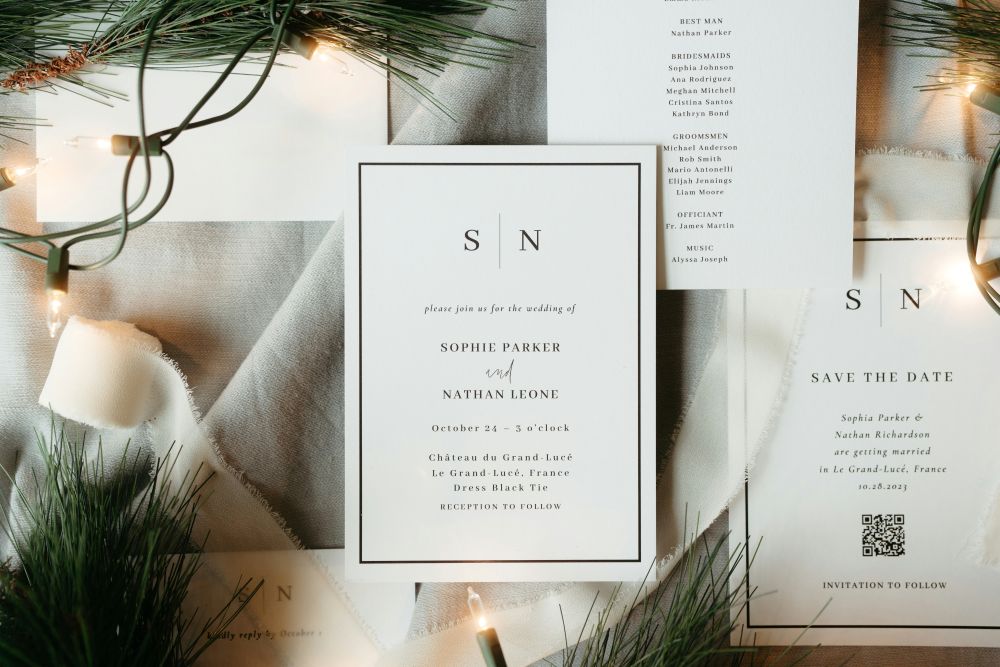
- It contributes to your photography – flat lay detail shots of your stationery suite are a consistent feature of modern wedding photography. A beautifully designed suite adds to the visual story of your day
- It reflects your overall design aesthetic – when your stationery palette, fonts, and style align with your florals, venue decor, and overall aesthetic, the whole day feels more cohesive
The Core Decision
Before you contact a designer or open a template platform, ask yourself:
1. What is your overall wedding aesthetic? Melbourne’s extraordinary venue diversity means the aesthetic range here is genuinely wide. A heritage ballroom wedding calls for entirely different stationery to a Collingwood warehouse event, a Yarra Valley vineyard estate, or an intimate coastal Mornington Peninsula celebration. Your stationery aesthetic should match your venue as much as it matches your personal taste.
2. What is your stationery budget? Melbourne’s premium creative market means stationery costs can be higher here than in other states, particularly for full custom design and specialty printing. Set a clear budget before you start so you can direct your investment to the right tier of product.
3. How many guests are you inviting? Quantity affects cost significantly. Know your approximate guest count before you start.
4. Do you want printed or digital stationery? Or a combination? This decision affects budget, lead time, and the overall feel of your guest experience.
5. How much design involvement do you want? Melbourne has exceptional designers available at every tier, from template platforms to full bespoke suites. Knowing how involved you want to be in the design process shapes which approach is right for you.
The Invitation Suite
The invitation suite is the collective term for all the printed pieces sent to guests before the wedding. Understanding what each component does helps you decide what your specific wedding actually needs.
Save the Dates
What they are: A preliminary notice sent to guests to reserve your wedding date before the formal invitation arrives.
What to include: Your names, the wedding date, the general location, and a note that a formal invitation will follow. A wedding website URL if you have one.
When to send: Six to twelve months before the wedding. For Yarra Valley and Mornington Peninsula weddings where guests may need to book accommodation, leaning toward the longer end is considerate. For local Melbourne celebrations, six to eight months is generally sufficient.
Format options: Printed card, postcard, magnet, or digital. Save the dates have a higher tolerance for digital delivery than formal invitations, particularly for younger guest lists.
Do you need them? Most useful for peak period weddings (October to December, March), for regional venue weddings where guests need to book accommodation, and for events where many guests are travelling from interstate. For smaller local celebrations with a generous invitation lead time, they are optional.
The Invitation
What it is: The formal request for your guests to attend your wedding. The centrepiece of your stationery suite.
What to include: The hosting party’s names, the couple’s names, ceremony date, day and time, ceremony venue name and address, and RSVP instructions.
When to send: Six to eight weeks before the wedding for most Melbourne weddings. Eight to ten weeks for larger events or celebrations requiring significant travel.
Design considerations: Melbourne couples often have a strong aesthetic point of view, and the city’s stationery designers match that energy. Take time to find a designer whose work genuinely resonates with your vision. Every other piece in your suite should feel visually connected to the invitation, so this is the right place to concentrate your design investment.
Printing methods and what they mean:
- Digital flat printing – the most common and most affordable method. Can produce beautiful results with quality paper stock and good design
- Letterpress – presses the design into thick cotton paper, creating a debossed tactile impression. Melbourne has several excellent letterpress printers. Premium look and feel, and a printing method that suits the city’s appreciation for craft and tactile quality
- Foiling – metallic or coloured foil applied to specific design elements. Gold, silver, and rose gold are popular. Adds cost but creates a luxury finish that photographs beautifully
- Engraving – the most formal and expensive printing method. Reserved for very formal and high-budget stationery suites
RSVP Card
What it is: A response card included with the invitation that guests return to confirm attendance and provide required information.
What to include: A response deadline, attendance confirmation, meal selection if required, and a dietary requirements field.
RSVP method options:
- Printed card with return envelope – traditional and still expected for formal Melbourne weddings. Include a pre-addressed and stamped return envelope
- Wedding website RSVP – increasingly common and accepted across all demographics. More convenient and easier to track
- Email RSVP – works for informal weddings and younger guest lists
- Combination – include a printed RSVP card and also list a wedding website URL. A practical approach for Melbourne’s typically mixed-age guest lists
Details Card
What it is: A supplementary card providing additional information not on the invitation itself.
What to include: Wedding website URL, accommodation recommendations, parking or transport information, dress code if not on the invitation, reception venue details if different from ceremony, and any other practical information guests need.
Melbourne note: Parking and public transport information is genuinely useful for Melbourne CBD and inner-suburb venue weddings, where guests may be choosing between driving, using public transport, or booking a car service. Including a brief note on the easiest options prevents unnecessary questions in the weeks before the wedding.
For Yarra Valley and Mornington Peninsula weddings: A well-prepared details card or wedding website page covering accommodation options, driving directions, and local area information is particularly valuable for guests unfamiliar with the region.
Other Suite Components
- Envelope liners – decorative paper lining inside the envelope. An elegant detail that suits Melbourne’s appreciation for design craft
- Wax seals – popular on envelope flaps and a strong fit for Melbourne’s craft-forward aesthetic
- Belly bands – bands of paper or ribbon wrapping the assembled suite
- Vellum overlays – translucent vellum sheets placed over the invitation. Popular in contemporary and romantic design styles
On-the-Day Stationery
These are the items your guests interact with on the wedding day itself. They need to be consistent in design with your invitation suite and with each other.
Order of Service
What it is: A printed guide to the ceremony that helps guests follow proceedings and feel oriented rather than confused.
What to include: The couple’s names, date and venue, order of proceedings, names of the officiant and any readers or performers, and the words to any hymns or songs guests are invited to sing.
Format options: Single folded card, booklet, bifold, or single flat card. For Melbourne’s heritage and formal venue weddings, a folded booklet is a considered and appropriate format. For more casual outdoor events, a single flat or folded card is practical and clean.
Do you need one? Not essential for very short civil ceremonies. More useful for longer ceremonies, religious ceremonies, or ceremonies with music and readings guests will want to follow.
Menus
What they are: Printed cards listing meal courses at each place setting or table.
What to include: Course names and descriptions, allergen information if relevant, and optionally the couple’s names and date as a keepsake detail.
Format options: Single flat card, tent card, folded card, or a design element incorporated into the table styling. Melbourne’s high-end catering culture means well-designed menus are expected at formal events and contribute meaningfully to the overall table aesthetic.
Do you need them? For plated meals, yes. For cocktail-style or grazing-table receptions, optional.
Place Cards
What they are: Small cards at each place setting identifying where a specific guest is seated.
What to include: The guest’s name, and optionally their meal choice. Keep it simple.
Format options: Tent card, flat card in a holder, escort card on a string, or a name written on a natural element. For Melbourne’s warehouse and industrial venues, a clean, minimal place card format suits the aesthetic. For garden and vineyard events, natural material options work beautifully.
Table Numbers
What they are: Numbers or names identifying each table.
Options: Numbered tables are most straightforward. Some Melbourne couples choose named tables – Melbourne laneways, significant streets, wine regions – for a more personal touch. If you use names rather than numbers, ensure a clear seating system so guests can find their table.
Format options: Printed card in a frame or holder, acrylic number, or a designed element tying into the overall decor. Table numbers at Melbourne’s more formal venues are often part of the broader table styling coordinated through your florist or venue stylist.
Other On-the-Day Items
- Favour tags – small tags attached to guest favours. Worth keeping consistent with your overall stationery aesthetic
- Gift table or wishing well sign – appreciated by guests who are unsure where to place cards or gifts
- Ceremony programs for children – a simple activity sheet for younger guests. A thoughtful detail that keeps children engaged during the ceremony
Signage
Wedding signage serves both a practical wayfinding function and a decorative design function. In Melbourne, where venue aesthetic is often a strong part of the wedding identity, well-designed signage contributes meaningfully to both the atmosphere and the photography.
Welcome Sign
A sign at the entrance welcoming guests and displaying the couple’s names and date. The most universally included sign at Australian weddings.
Common formats: Large framed print, mirror with vinyl lettering, timber board with hand lettering, acrylic board, or a chalkboard. For Melbourne’s industrial and warehouse venues, a large format printed sign on a minimal frame or a hand-painted timber board suits the aesthetic well. For garden and estate venues, a botanical-styled acrylic or timber board is a popular choice.
Seating Chart
A displayed chart showing guest table assignments.
What to include: Guest names and their table assignment. Alphabetical listing by last name is most user-friendly for larger guest lists, which are common at Melbourne weddings.
Common formats: Printed and framed poster, mirror with printed names, acrylic board, or timber board with inserts. For Melbourne’s formal heritage venues, a large framed printed chart suits the space. For warehouse and industrial venues, an oversized minimal acrylic or timber board often works better.
Practical note: Your seating chart must be finalised very close to the wedding. Choose a format and supplier that can accommodate late updates, and confirm your supplier’s cut-off date for changes.
Bar Menu
A sign at or behind the bar listing drinks available. Melbourne’s sophisticated food and beverage culture means a well-designed bar menu is a genuinely appreciated detail. Signature cocktails with named menu cards are particularly popular at Melbourne receptions.
Directional and Wayfinding Signs
Signs directing guests to the ceremony, reception, bathrooms, parking, or shuttle pick-up points. Most important at multi-area venues and larger regional properties.
Melbourne note: For Yarra Valley, Mornington Peninsula, and Dandenong Ranges venues where guests are navigating larger rural properties, clear directional signage at key decision points is genuinely useful. For inner-Melbourne venues, directional signage within the venue is typically more relevant than external wayfinding.
Other Signage
- Food station labels – identifies dishes at grazing tables or cocktail stations
- Photo booth props sign – instructions at a photo booth area
- Social media hashtag sign – displays your wedding hashtag
- Cards and gifts sign – directs guests to the correct table
- Order of the day sign – a timeline of events displayed at the reception
Digital vs Printed Stationery
The decision between digital and printed stationery is not all-or-nothing. Most couples end up with a combination, and the right balance depends on your guest list, budget, values, and aesthetic priorities.
The case for printed stationery:
- A printed invitation is a physical object guests hold, keep, and display. It communicates care and occasion in a way a digital message cannot replicate
- Melbourne’s design culture means printed stationery is often highly valued and expected at formal events
- Printed stationery contributes to flat lay photography and the overall tactile experience of your wedding
- Letterpress and specialty printing are genuinely exceptional in Melbourne – the results available here are among the best in Australia
The case for digital stationery:
- Significantly lower cost, particularly for save the dates and RSVP management
- Faster turnaround and easier to update or correct after sending
- Environmentally lower impact if sustainability is a priority
- Very practical for RSVPs, which are easier to collect and track digitally
- Appropriate for informal weddings and younger guest lists
A practical hybrid approach: Many Melbourne couples send printed invitations but direct guests to a wedding website for RSVPs, accommodation, and updates. For regional venue weddings (Yarra Valley, Mornington Peninsula), a thorough wedding website with driving directions, accommodation recommendations, and venue information is particularly valuable for guests unfamiliar with the area.
DIY vs Professional Designer
This decision depends on your budget, design skills, available time, and how much your stationery aesthetic matters relative to other priorities.
DIY using templates: Platforms like Canva, Etsy, and dedicated wedding stationery template sites offer professionally designed templates you can customise. Best suited to couples with some design instinct, a clear aesthetic, and a desire to keep costs down. Melbourne’s design-conscious culture means a well-executed DIY suite is entirely respected.
Semi-custom design: A professional designer creates a base design customised with your details and colours. A strong middle ground that many couples find gives the best balance of quality and value. Melbourne has excellent semi-custom stationers at a range of price points.
Full custom design: A professional designer creates your entire suite from scratch to your specific brief. The most expensive option and the one requiring the most lead time. Best suited to couples with a very specific vision, a higher stationery budget, and genuine care about every design detail. Melbourne’s full custom stationery designers are outstanding.
Questions to ask a stationer or designer before booking:
- What is included in the quoted price – design, printing, or both?
- How many rounds of revisions are included?
- What is the production and delivery timeline?
- What paper stocks and printing methods do you offer?
- Can you supply a physical sample before the full order is printed?
- How do you handle errors or printing defects in the final product?
Melbourne’s independent stationery and calligraphy community is one of the strongest in Australia. Local designers offer physical proofing, in-person consultations in many cases, and a level of responsiveness that interstate and international suppliers cannot match.
Wording and Etiquette Basics
Wedding invitation wording has traditional conventions and modern variations. Understanding them helps you make deliberate choices.
Who is hosting? Contemporary practice has largely shifted to couples hosting their own weddings. Common modern formats include “Together with their families, [Name] and [Name] invite you…” or simply “We invite you to celebrate with us…”
Names: Use full names on formal invitations. First names only are appropriate for casual or informal celebrations.
Date and time: Formal invitations traditionally spell these out in full. Modern invitations more commonly use a clear mixed format (“Saturday 14 September 2027 at 3:30 pm”). Use the format that matches your overall tone.
Venue: Include the full venue name and address. For regional venues (Yarra Valley, Mornington Peninsula), including the suburb or town in addition to the venue name is helpful for guests. For events at multi-space venues with a ceremony at one location and reception at another, clearly differentiate both.
Dress code: Include dress code on the invitation or details card. Melbourne guests appreciate clear guidance, and the city’s range of venue types means the appropriate dress code genuinely varies. Add a brief practical note for outdoor or semi-outdoor events – weather layers, footwear considerations on vineyard gravel.
RSVP deadline: Set your RSVP deadline at least three to four weeks before the wedding.
Gift guidance: Include gift registry or wishing well information on the details card or wedding website rather than on the invitation itself.
Children: If your wedding is adults-only, communicate this clearly but kindly. A simple note on the details card or wedding website is direct and considerate.
What Actually Works
Step 1: Set a stationery budget early. Total your expected spend across all items: save the dates, invitation suite, on-the-day stationery, and signage. Melbourne’s premium market means total stationery costs can be higher here than in other states. Know the full picture before you start.
Step 2: Finalise your guest list before you contact any designer or printer. Quantity drives cost. You cannot get an accurate quote without a guest count.
Step 3: Lock in your overall design aesthetic before approaching a stationer. Melbourne’s venue diversity means your stationery aesthetic needs to be aligned with both your personal taste and the specific setting you have chosen. Bring reference images to any designer conversation.
Step 4: Contact a designer or begin your design process five to six months before the wedding. Melbourne’s best designers are booked well in advance, particularly for October through December and March peak seasons. Start this process early.
Step 5: Proof everything meticulously before approving for print. Check every name spelling, every address, every date, every time, every URL. Ask a second person to proof independently.
Step 6: Order more than you need. Order ten to fifteen percent more than your current guest count for keepsakes, late additions, and photographer flat lays. It is significantly cheaper to order extras in the original print run than to reorder a small quantity later.
Step 7: Weigh your assembled invitation suite before buying postage. Take a fully assembled invitation to Australia Post before buying postage in bulk. An invitation that feels light can still require additional postage once fully assembled.
Step 8: Set a realistic RSVP deadline and plan to chase non-responders. Set the deadline three to four weeks before the wedding. At least a third of guests will not respond by the deadline. Build in time to follow up.
Step 9: Brief your on-the-day stationer at the same time as your invitation designer. Menus, place cards, and signage should feel visually consistent with your invitation suite. Brief them together or from the same design system.
Step 10: Finalise your seating chart as late as your supplier allows. Guest numbers and table assignments change close to the wedding. Know your supplier’s finalisation deadline.
Step 11: Coordinate with your florist and stylist on signage. Some items (table numbers, sign frames, easels) are sourced through stylists rather than stationers. Confirm responsibility for each item so nothing falls between suppliers.
Step 12: Keep a digital copy of all final approved files. Store approved stationery files in a clearly organised folder for easy access if a last-minute reprint is needed.
Budget reality breakdown (Melbourne):
Invitation suite (80 guests, printed, semi-custom):
- Save the dates: $180 to $420
- Invitation suite (invitation, details card, envelope): $420 to $1,100
- RSVP cards and return envelopes (if printed): $120 to $300
- Postage (outgoing): $80 to $220 depending on weight and quantity
On-the-day stationery (80 guests):
- Order of service (if required): $180 to $420
- Menus (per table or per place): $130 to $360
- Place cards: $100 to $300
- Table numbers: $70 to $250
Signage:
- Welcome sign: $100 to $420
- Seating chart: $150 to $550
- Bar menu sign: $80 to $230
- Additional directional or decorative signs (each): $60 to $220
Full stationery suite estimate (80 guests, printed, semi-custom):
- Budget range: $1,500 to $4,200+
- Custom design and premium printing: $4,500 to $9,000+
- DIY template approach: $500 to $1,300 (design and printing costs only)
Melbourne-specific considerations:
- Melbourne has one of the strongest independent stationery and letterpress communities in Australia. The quality available here from local designers and printers is exceptional and worth seeking out
- Venue aesthetic significantly shapes the right stationery style in Melbourne. A heritage ballroom calls for something entirely different to a Collingwood warehouse or a Yarra Valley estate. Let your venue guide your design direction
- Parking and public transport information on a details card or wedding website is genuinely practical for inner-Melbourne venue weddings
- Peak seasons (October to December and March to May) put significant pressure on Melbourne stationer availability. Book your designer 12 months out for peak dates
- Melbourne’s design culture supports and expects creative, distinctive stationery choices. If you want something non-traditional, unusual, or highly personalised, this is the city where you will find the designers to deliver it
Final Thoughts
Wedding stationery is more than paperwork. It is the beginning of your guests’ experience of your wedding, and it is the visual system that ties your entire day together. Done thoughtfully, it reflects your personality, sets the right expectations, and contributes to the overall beauty of the day.
Melbourne gives you access to some of the best stationery and design talent in Australia. Whether your wedding calls for classic letterpress on cotton stock, a minimal modern suite with clean typography, a lush botanical design that echoes your florals, or something unexpected and distinctly personal, you will find a designer here who can deliver it.
Start with a clear budget and aesthetic. Book your designer early. Proof everything twice. And choose stationery that feels genuinely like you and genuinely like your wedding.
👉 Ready to find your Melbourne wedding stationer or calligrapher? Explore our directory of Victorian stationery professionals and read reviews from real couples who have celebrated with them.
Further Reading
- Celebrity-Inspired Wedding Invitation Wording – Melbourne Edition
- How to Create a Wedding Guest List in Victoria
- 15 Creative Wedding Invitation Wording Examples for Melbourne and Victoria Weddings
Starting Points
- Melbourne Wedding Cakes: Where to Start
- Melbourne Wedding Fashion and Attire: Where to Start
- Melbourne Wedding Hair and Beauty: Where to Start
- Melbourne Wedding Videography: Where to Start
- Melbourne Wedding Music & Entertainment: Where to Start
- Melbourne Wedding Catering + Food & Beverage: Where to Start
- Global Wedding Inspiration: How to Bring the World Home to Melbourne
- Melbourne Wedding Flowers & Styling: Where to Start
- Melbourne Wedding Photography: Where to Start
- Melbourne Wedding Celebrants: Where to Start
Next Step
Explore Vendors
Whether you’re planning a small, intimate gathering or a grand celebration, Wedding VIC has the perfect suppliers to help you create a truly memorable event in Melbourne and Victoria. So start browsing our directory today and find everything you need to make your special day unforgettable.